The Complete
Parakite Guide
The Dunewing team tells you everything about this fascinating discipline — how it works, level required, gear selection and safety.
Read the guideWhat is a parakite?
Definition and how it flies
Parakites are deeply modified paragliding wings whose angle of attack can be changed in flight simply by raising your hands. This apparently simple gesture radically transforms the behaviour of the wing.
The brakes deform the trailing edge as on any paraglider, but they are also coupled to the rear risers — allowing them to lengthen when you raise your hands. The wing then pitches forward, generating a diving trajectory and a significant increase in speed.
The kinetic and potential energy accumulated during this dive phase can then be used to perform a large pull-out, or flare, over a long distance by lowering your hands.
The neutral position
The neutral position is clearly identified on all parakites — typically hands at shoulder level. This is the position that offers the best glide ratio.
- Above neutral: the wing accelerates with a diving trajectory
- Below neutral: you slow down progressively until approaching the stall point, like with a conventional paraglider
To reduce the risk of collapses, parakites are heavily reinforced and designed with a strong reflex effect. They are very difficult to collapse. You can actually find videos of pilots deliberately pulling on the A-risers: the wing surges forward and pitches down without collapsing.
The result: a wide speed range, solid stability at high speed and very dynamic handling to play with the terrain, flare long, climb back upwind and land short. This is not a conventional paraglider — the gestures, trajectories and energy management are specific.
What are parakites for?
Sensations, terrain play and flying pleasure
Parakites are above all fantastic generators of pleasure and strong sensations. They let you rediscover the excitement of your first flights, with an extra dimension: energy play.
The ability to dive intentionally dramatically increases the options for playing with terrain and ground proximity. Parakites are perfectly suited for:
- Descending mountains while staying close to the terrain
- Dynamic soaring at the coast or on dunes
- Playing with low, fast trajectories
- Long, thrilling landing flares
The speed also transforms landing phases: you come in fast and flare over a very long distance, delivering particularly intense sensations.
Before you start
Essential prerequisites and a progressive approach
Flying fast and close to the ground is not something to improvise. Even though a parakite looks like a paraglider, its direct angle-of-attack control requires resetting certain reflexes and thoroughly understanding the flight mechanics before jumping into the wind. A rigorous approach is essential.
- Dedicated training. Parakite briefing (angle of attack, timing, trajectories, landing/launching) and a supervised session at a suitable site.
- Conditions and sites. Aim for laminar wind (clean dune or ridge). Avoid thermic or gusty wind, rotor effect and obstacles downwind. Ideal sites: Normandy coastline, Dune du Pilat.
- Progressive approach. Start lightly loaded (larger size), work on landings and launches before accelerating or searching for the dive.
- Appropriate equipment. Compact, robust harness with foam back protection, helmet, back protector, gloves. Meticulous pre-flight checks.
- Local rules. Respect zones, other users (riders, walkers), clubs, local bylaws, and common sense near cliff edges.
- Buddy system and margins. Eyes on take-off and landing, charged radios, generous vertical margins.
What you don’t do with a parakite
Limits and constraints of the practice
Parakites are not all-terrain wings. Understanding their limits is essential to flying safely.
- The hand position, often under tension, generates significant physical effort. Flying fast for a long time can become tiring.
- The concentration needed to fly fast and close to the ground is not sustainable over a long period — you need to know when to take breaks and recover.
- Flying in thermic or turbulent conditions is discouraged by manufacturers. Parakites are designed for laminar air and dynamic terrain-proximity flying.
Who are parakites for?
Required level and ideal pilot profile
Parakites are more demanding machines than a standard paraglider. They fly faster, dive more and require fine reading of terrain and airmass — making piloting more complex.
It is reasonable to have at least the equivalent of a full paragliding pilot licence before considering flying these machines. In very specific conditions — quiet sites, laminar coastal air — an earlier start is possible, but it is neither relevant nor sustainable.
Pilots must be comfortable with:
- Face-launch inflation in strong wind
- Moving laterally in the wind window
- Experience from a trip or course at Dune du Pilat or a coastal site
- Managing sustained wind conditions
Parakites are also for pilots capable of managing their own limits. They invite highly committed and extremely enjoyable flying — but one where clear-headed risk assessment must be fully mastered.
Which parakite size to choose?
Choosing the right surface area for your practice
Choosing the surface area is arguably the most critical decision. Unlike a conventional paraglider where you mainly rely on total flying weight (TFW) to find a certified range, the size of a parakite directly defines your usable wind window and margin for error.
- A wing that is too small is unforgiving and demands ultra-precise inputs — speed builds very fast.
- A larger surface area offers a gentler introduction, ideal for learning the angle-of-attack mechanics without being caught out.
Which parakites can you rent at Dunewing?
Four complementary references tested by the team
The Dunewing team has tested and selected four complementary references, available for rental:
Little Cloud La Mouette
Readable soaring machine with a “paraglider feel” while remaining a true parakite. Smooth angle-of-attack control, healthy stability. Size 19 to cover the most common TFW and wind ranges. Ideal for curious paraglider pilots and those wanting a progressive entry into the discipline.
Dudek Touch
Highly refined high-speed stability, reactive controls and a “planted” feel appreciated by many pilots. A well-balanced reference between responsiveness and handling comfort.
Level Wings FUZE
Reflex profile designed for precision, safety and performance. Exceptional roll reactivity — the “Level Touch” signature. Versatile: soaring, speedflying, snowkite. Remarkable stability even at high speed.
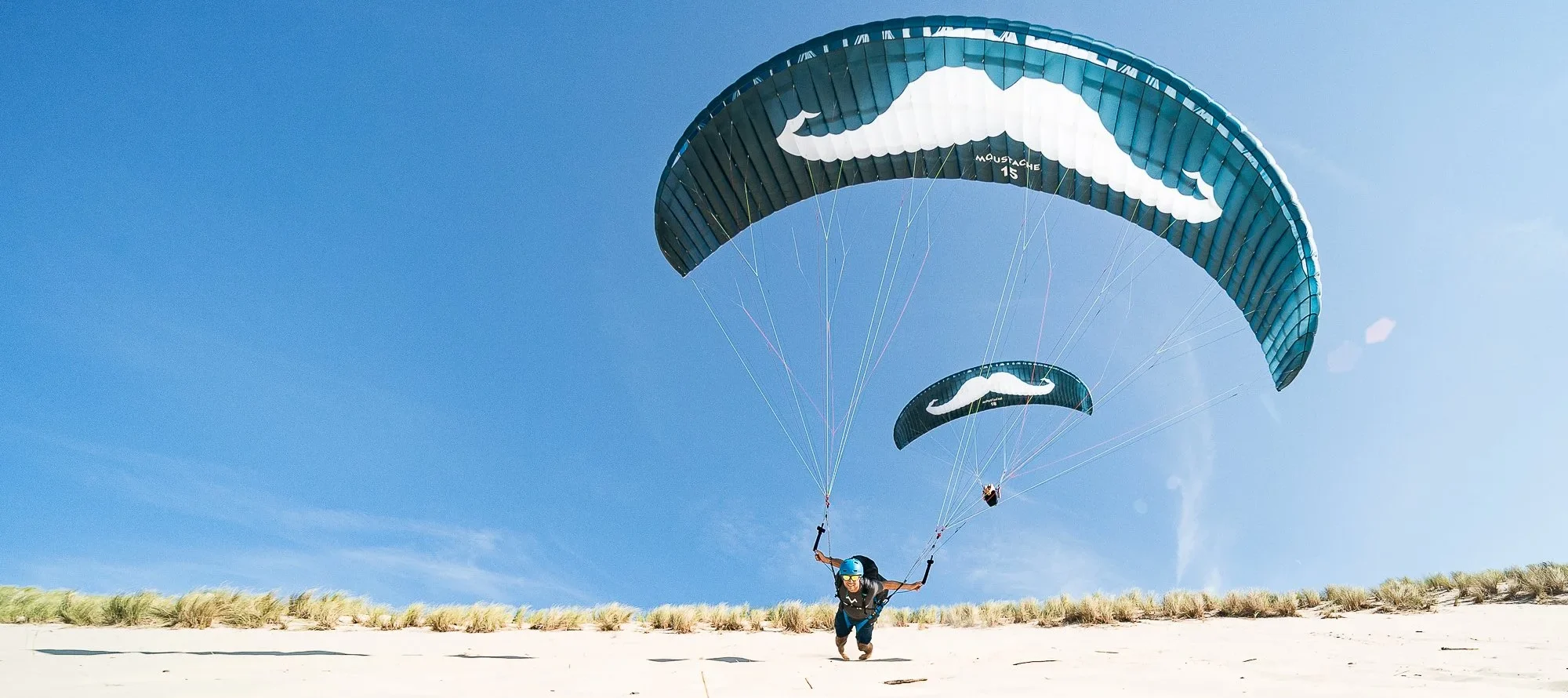
Flare Moustache²
Huge speed range, long flares and efficient upwind climbs. Specific riser system (B/C mix), refined practical details (drainage, ergonomics). For pilots already comfortable in strong wind and energy management.
- First parakite → La Mouette (based on style and TFW)
- Progression → Dudek Touch or Level Wings FUZE
- Energy and confirmed experience → Moustache² with serious work on timing
Which harness for parakite?
Essential equipment
Harness choice is often underestimated but crucial for safe and comfortable parakite flying.
- No seat plate required — and recommended against. Harnesses with a seat plate are unsuitable for parakite: they make the whole system too unstable and aggressive. Only seat-plate-free harnesses are appropriate.
- Hike & fly harnesses — many lightweight mountain flying harnesses work perfectly, reversible or not.
- Foam back protection — strongly recommended for parakite and speedflying, even though some pilots fly without it — which is not advisable.
- Helmet, back protector and gloves — full protective equipment remains essential for every flight.
In short: lightweight, robust, no seat plate, with foam back protection — these are the key criteria for choosing the right parakite harness.
Ready to fly?
Rent your parakite from Dunewing — checked equipment, briefing included, near the Dune du Pilat.
See available parakites
Leave a Reply